April Spotlight: Gillian Bull – Tapestry Weaver
Gillian Bull, a Sandwich-based textile artist, has been creating woven art and furnishing tapestries since the mid-1970s. Over the decades, she has explored the expressive possibilities of this ancient and highly tactile craft. (Also, probably, the very slowest form of art.)
Weaving carries a fascinating history. Some theories suggest that early humans developed advanced counting systems to manage the intricate processes of warp and weft—highlighting just how complex and intellectually engaging this art form can be.
Describing herself as basically a punk weaver (not trained in the fierce discipline of the great tapestry workshops), when developing designs for commissions or for herself she tries to ensure that there’s a good reason for producing the resulting work as a tapestry, rather than a painting or sculpture.
“What do you see in my work?”
Gillian draws inspiration from the richly detailed European tapestry traditions of the 16th and 17th centuries—pieces often filled with narrative depth, symbolism, and intricate visual storytelling. Each piece is designed to offer layers of meaning – besides her own as creator, whatever else they may trigger in the minds of viewers.

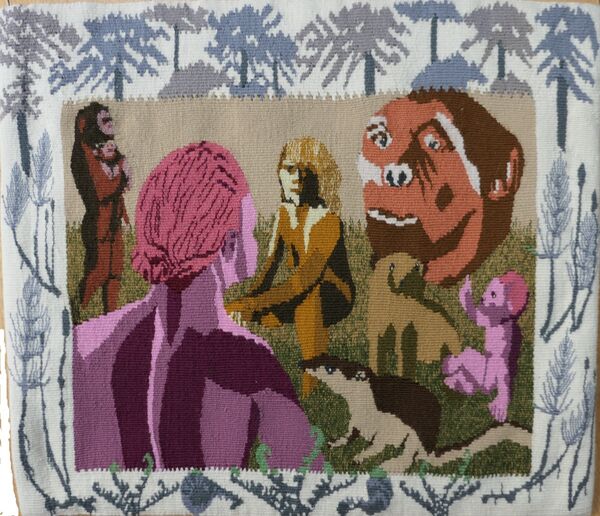
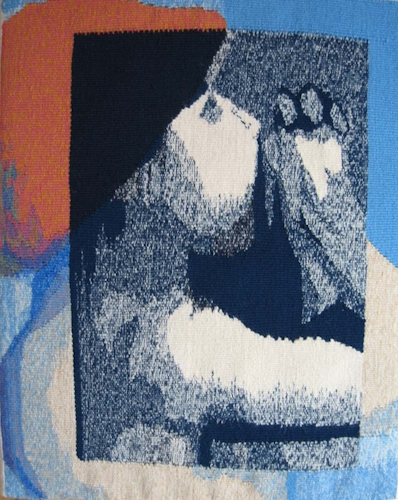
The featured image is entitled “CELEBRATION 1964: HEARING OTHER WAR BABIES’ MUSIC”
Here Gillian explains the process “The design and the cartoon took about six weeks early in 2025. The warp was made and then threaded onto the loom over a week early in April The cartoon was sewn onto the back of the first two inches of weft hem on 18th April . The tapestry was completed on the loom on 21st July. Off the loom, blocking and finishing took about a week, including making a calico backing sheet and hanging mechanism.”
On Closer Examination
Her two Turing Centenary Tapestries are located at Turing College, Kent University, Canterbury.
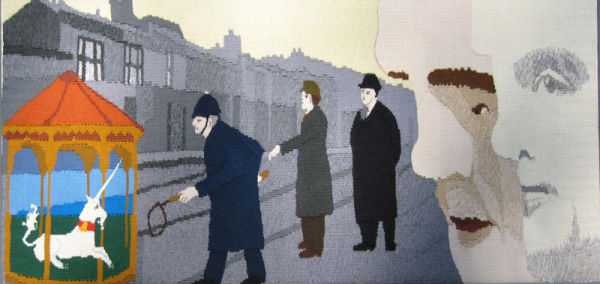
“TURING CORRECTED WITH OESTROGEN ”
The unicorn and three figures in this tapestry are all adapted from the famous series “The Hunt of the Unicorn.” The unicorn comes from “The Unicorn in Captivity,” while the other figures are inspired by characters from different scenes in the series.
The street background is based on a 1950s photograph of Salford, standing in for Oxford Road in Manchester, where Alan Turing met the young man connected to the events that led to his prosecution. The two faces on the right are both based on Turing, distorted to reflect the effects of the chemical treatment forced upon him.
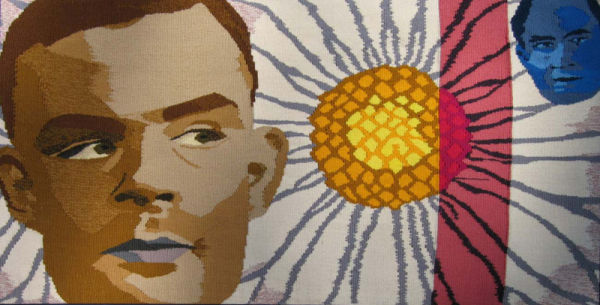
Also see “TURING, DAISY AND AVATAR”
The daisy in this tapestry represents Alan Turing’s lifelong fascination with morphogenesis and patterns in nature. Even as a boy he was known for stopping to study flowers, and at Bletchley he was often seen counting petals, leaves and stamens in the countryside.
The avatar included in the design reflects the digital worlds Turing helped make possible. Gillian imagined who he might have chosen as an avatar for himself, and settled on John von Neumann, his contemporary at Princeton.
“Gillian has chosen Gymnopédi No 1 by Erik Satie as her mood music. Perfect for quiet contemplation.”
Explore more of Gillian’s work here
www.thebritishtapestrygroup.co.uk